Chenggang Chen

I am an incoming Tenure-Track Assistant Professor in the School of Biomedical Engineering at Tsinghua University, where I will lead the Computational Audition and NeuroAI Laboratory (CANAL) as PI.

My lab's long-term interest lies in auditory perception within both clean and complex scenarios, such as the "cocktail party", where state-of-the-art AI models and individuals relying on cochlear implants or hearing aids often struggle. We aim to understand the neural mechanisms of hearing, build NeuroAI models that operate robustly in complex acoustic environments, and improve the listening experience for those with hearing impairments.

To achieve this, 1) we will integrate invasive neurophysiological recordings and psychoacoustics in marmoset monkeys to assess the single-neuron correlates of auditory perception.
2) Additionally, we will collect noninvasive human fMRI and EEG data in combination with psychoacoustics, allowing us to study auditory perception unique to humans, such as speech and music.
3) We will conduct this research with both normal-hearing individuals and those who rely on hearing aids or cochlear implants.
4) Finally, brain-inspired NeuroAI models trained in real-world environments will help us model brain responses and perceptual behaviors in both marmosets and humans, which will inspire new experimental studies.

Email  /  LinkedIn  /  ResearchGate  /  OpenReview  /  CV  /  Google Scholar   

profile photo

Educations


Ph.D. in Biomedical Engineering, Tsinghua University, Beijing, China, 2011.08-2018.07
B.S. in Biomedical Engineering, Jilin University, Changchun, China, 2007.08-2011.07

Professional Experience


Assistant Professor, Tsinghua University, Beijing, China, 2026.07
Research associate, Johns Hopkins University, Baltimore, MD, 2024.10-2026.06
Postdoctoral fellow, Johns Hopkins University, Baltimore, MD, 2018.09-2024.09

profile photo

Publications

My expertise includes systems and computational auditory neuroscience using the marmoset monkey as a nonhuman primate model, as well as NeuroAI modeling. I have published extensively in both the neuroscience and AI/ML fields.

In neuroscience, my first-author (ranked first or solo) publications include Nature Communications (2025), PLoS Biology (2026), The Journal of Neuroscience (2018 and 2024), Communications Biology (2019), and Hearing Research (2023, Cover Paper).

In the AI/ML field, I have published as the sole first and sole corresponding author in ICML 2026 [Spotlight, Top 2.2%], NeurReps 2025, IJCNN 2025, and NeurIPS 2024 [Top 2%].

Real-World Unsupervised Models Generalize to Predict Brain Responses to Out-of-Distribution Stimuli
Chenggang Chen, Zhiyu Yang, Xiaoqin Wang
ICML, 2026   (Spotlight, Top 2.2%)

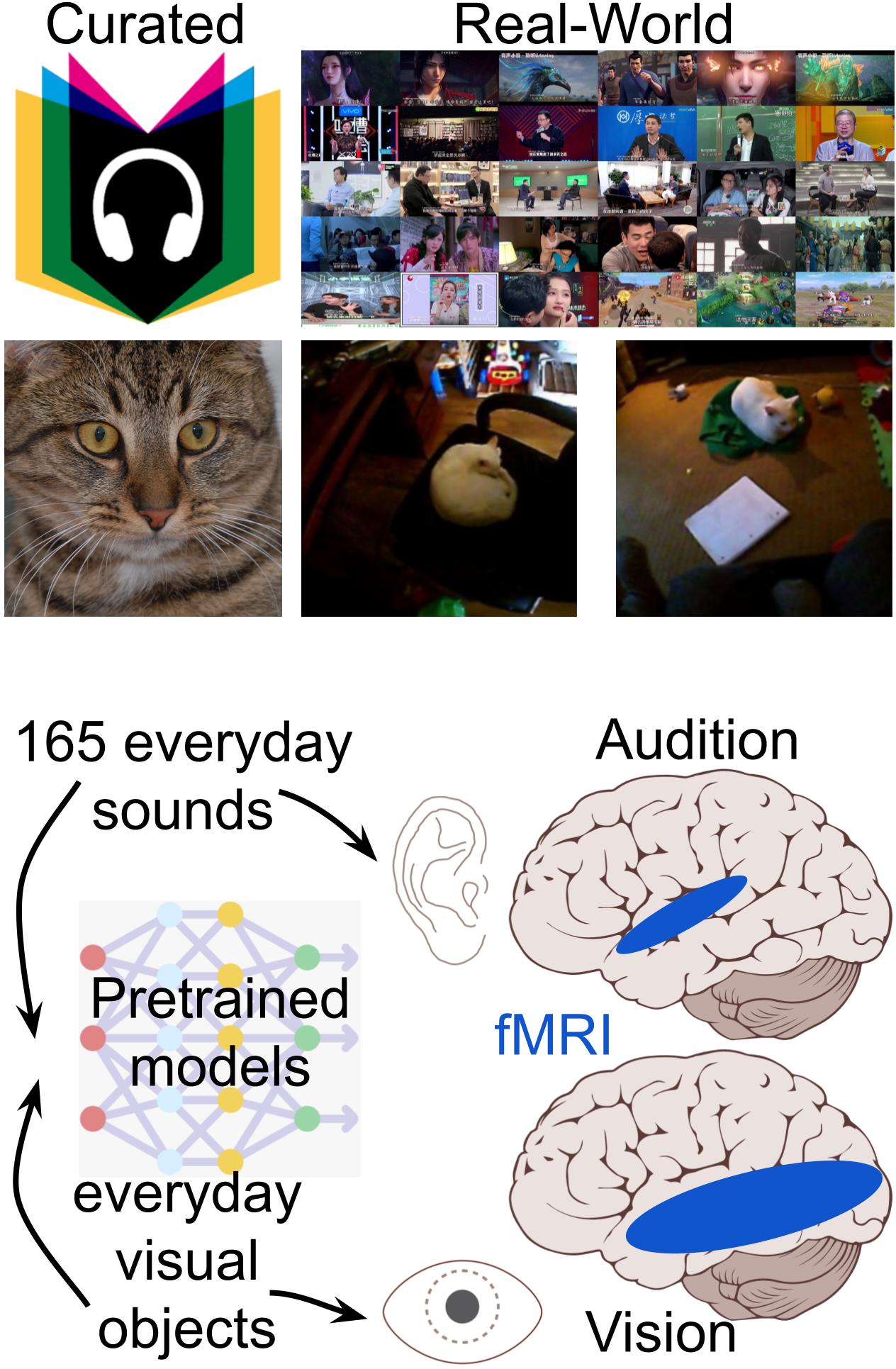
Deep neural networks currently provide the leading quantitative models of neural responses in sensory systems. However, these networks remain implausible as models of sensory development, largely because they rely on supervised training with label efficiency far exceeding that of biological learning. Furthermore, these models are typically trained on manually curated datasets that lack the statistical properties of the natural environments to which the brain is exposed.
Here, we demonstrate that models trained with unsupervised objectives on real-world data significantly outperform supervised models in predicting brain responses across both human auditory and visual cortex. We show that this performance advantage is not driven by network architecture or dataset size, but rather by the data distribution.
Crucially, we find that unsupervised models trained on real-world data exhibit remarkable out-of-distribution generalization: a model trained exclusively on Mandarin speech accurately predicts English-driven brain responses, and a model trained on infant head-cam footage predicts adult visual responses to curated object images.
Together, our results illustrate how deep neural networks can be used to reveal the real-world statistics that shape neural representations in the brain

Location-specific neural facilitation in marmoset auditory cortex
Chenggang Chen, Sheng Xu, Yunyan (Jennifer) Wang, Xiaoqin Wang
Nature Communications, 2025

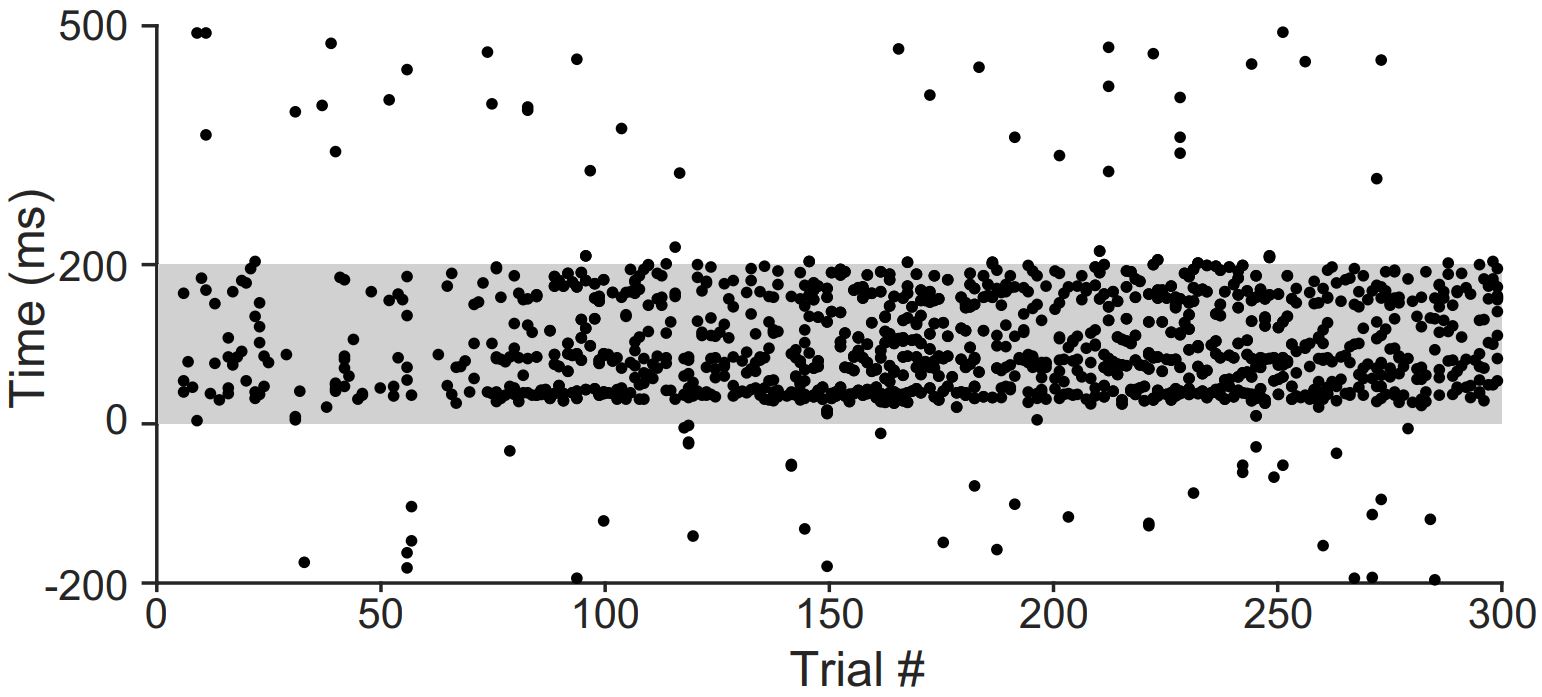
A large body of literature has shown that sensory neurons typically exhibit adaptation to repetitive stimulation. Here, we investigated single neuron responses to sequences of sounds repeatedly delivered from a particular spatial location. Instead of inducing adaptation, repetitive stimulation evoked long-lasting and location-specific facilitation (LSF) in firing rate of nearly 90% of recorded neurons.
Our findings reveal a novel form of contextual and bottom-up attention modulation in the marmoset auditory cortex that may play a role in tasks such as auditory streaming and the cocktail party effect.

What and where manifolds emerge and align with perception in deep neural network models of sound localization
Chenggang Chen, Zhiyu Yang, Xiaoqin Wang
NeurReps, 2025 (Score: 885)

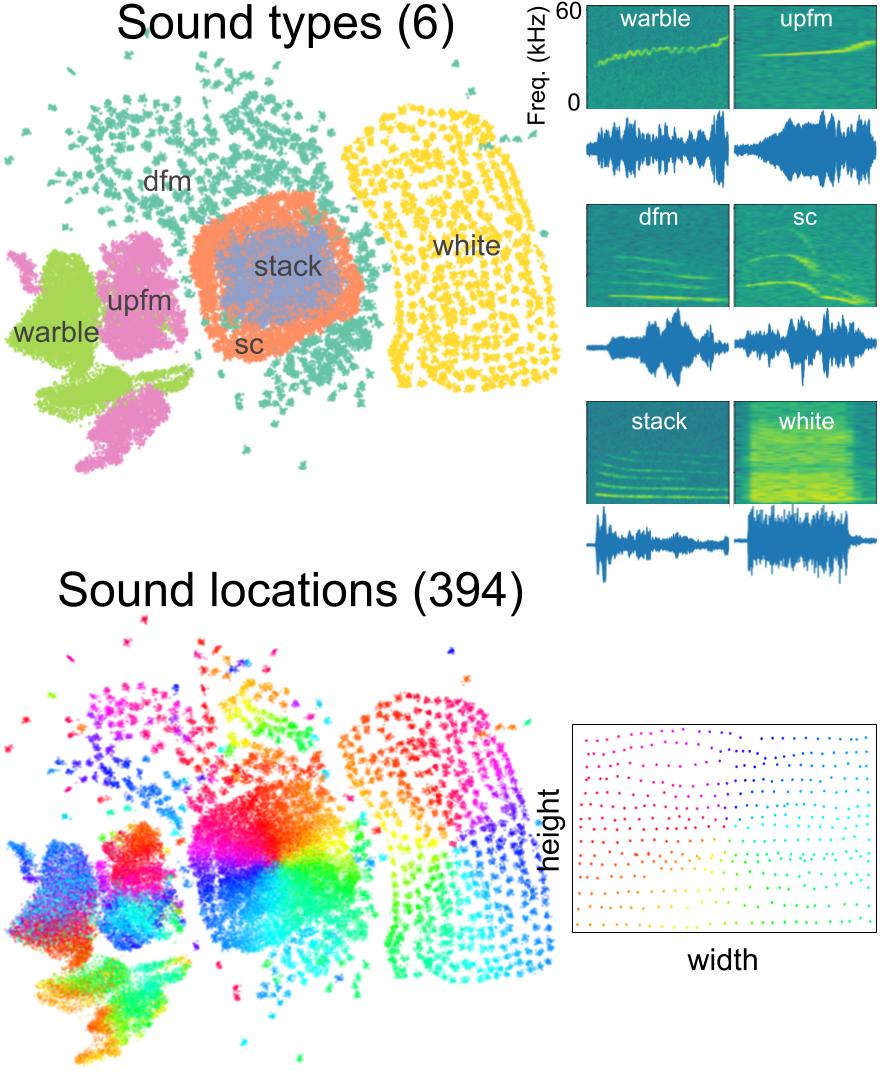
Whether the auditory cortex has parallel pathways for sound identification (“what”) and localization (“where”), and whether it contains a map of auditory space, is debated. Here, we examined the low-dimensional structure (manifold) of “what” and “where” representations in deep neural network models of sound localization.
Unexpectedly, models trained for “where” learned untangled “what” manifolds, including voice type, reverberation, and spectral detail. The distribution of “what” manifolds was not random, but geometrically organized by spectral similarity. The separability and distance of both “what” and “where” manifolds were aligned with human behavior.
Together, object manifolds reveal learned task-irrelevant attributes of object that are ignored when measuring task performance alone, and task-optimized neural networks can provide insights into brain and behavior, not just replicate them.

Neural Embeddings Rank: Aligning 3D latent dynamics with movements
Chenggang Chen, Zhiyu Yang, Xiaoqin Wang
NeurIPS, 2024   (Score: 776, Top 2%)

Aligning neural dynamics with movements is a fundamental goal in neuroscience and brain-machine interfaces. However, there is still a lack of dimensionality reduction methods that can effectively align low-dimensional latent dynamics with movements. To address this gap, we propose Neural Embeddings Rank (NER), a technique that embeds neural dynamics into a 3D latent space and contrasts the embeddings based on movement ranks.
Using a linear regression decoder, NER explains 86% and 97% of the variance in velocity and position, respectively. Linear models trained on data from one session successfully decode velocity, position, and direction in held-out test data from different dates and cortical areas (64%, 88%, and 90%).

Behavioral engagement facilitates auditory neuron responses beyond their receptive fields
Chenggang Chen, Evan D. Remington, Xiaoqin Wang
PLoS Biology, 2026

In the auditory cortex, neural responses to stimuli inside receptive fields (RFs) can be further facilitated by behavioral demands, such as attending to a spatial location. It is less clear how off-RF stimuli modulate neural responses and contribute to behavioral tasks. To explore this question, we trained marmosets to attend to sound locations that were either inside or outside the RFs of auditory cortical neurons.
The majority of neurons showed increased firing rates at target locations inside their RFs. Interestingly, this increase also occurred outside the RFs, sometimes exceeding the responses at the RF center during passive listening.
These results suggest that behavioral task and top-down attention demands recruit a broader range of neurons.

Oral Presentations


2020 Marmoset Bioscience Symposium by Drs. Cory Miller and Kuo-Fen Lee, online
2021 Adv. & Persp. in Aud. Neurosci. (APAN) by Drs. Xiaoqin Wang, Yale Cohen, and Liz Romanski, online
2022 International Conference on Mathematical Neuroscience by ESMTB, online
2022 45th Association for Research in Otolaryngology (ARO) Annual Meeting, San Jose, CA
2022 9th Midwest Auditory Research Conference (MARC) by Univ. of Michigan, Ann Arbor, MI
2023 46th Association for Research in Otolaryngology (ARO) Annual Meeting, Orlando, FL
2023 Binaural and Spatial Hearing (BASH) by Drs. Chris Stecker and Gin Best, Omaha, NE
2023 9th BRAIN Initiative Annual Meeting by NIH, Bethesda, MD
2023 Electronic Auditory Research Seminars by Drs. Maria Geffen, Yale Cohen, Online
2024 47th Association for Research in Otolaryngology (ARO) Annual Meeting, Anaheim, CA
2024 Neural Information Processing Systems (NeurIPS) SSL Workshop, Vancouver, Canada
2024 Gordon Research Conference (GRC) by Drs. Allison Coffin, Michael Roberts, Smithfield, RI
2024 Marmoset Principal Investigator (PI) Meeting by Dr. Cory Miller, Boulder, CO
2025 10th Midwest Auditory Research Conference (MARC) by NEOMED, Rootstown, OH
2026 Marmoset Bioscience Symposium by Drs. Lingyun Zhao and David Schaeffer, Pittsburgh, PA

Grants, Honors, and Awards


2009 Samsung Scholarship
2008 National Scholarship
2009 China Undergraduate Mathematical Contest in Modeling (CUMCM) National Second Prize
2009 China Undergraduate Mathematical Contest in Modeling (CUMCM) Jilin Province First Prize
2010 Suzhou Industrial Park Scholarship
2010 National Scholarship
2010 Top Ten Students (Jilin University School of Electronics)
2011 Summa cum laude (Jilin University)
2018 Best Presentation Award, IDG/McGovern Institute for Brain Research at Tsinghua University
2022 ARO Member Spotlight
2022 NWB Hackathon Travel Award
2022 Neurodata Re-Analysis Travel Award
2022 Kavli Foundation Seed Grant
2022 MARC Travel Award
2023 BRAIN Initiative Annual Meeting Trainee Highlight Award
2023 ARO Annual Meeting Travel Award
2025 MARC Travel Award